Language development follows a broad pattern of milestones—from coos and babbles in infancy through single words, sentences, and eventually storytelling—but the timeline varies widely among children who all end up talking fluently. Knowing what changes to expect at each age helps you notice when your child is progressing, decide whether a delay needs attention, and understand that normal development looks different in every child. Children learn language by hearing it, trying sounds, playing with them, and getting responses from the people around them. This process starts long before the first word and continues through the preschool years, shaped by how much talking, singing, reading, and face-to-face interaction they experience at home.
Table of Contents
- Sounds Before Words—Birth to Six Months
- Babbling and Comprehension—Six to Twelve Months
- First Words and Early Understanding—Twelve to Eighteen Months
- Two-Word Phrases and Grammar Beginnings—Eighteen to Twenty-Four Months
- Storytelling and Complex Speech—Two to Four Years
- What Counts as a Speech Delay
- How to Support Speech and Language at Home
- Bilingualism and Language Exposure
- Signs to Bring to Your Pediatrician
- When to Seek a Speech-Language Evaluation
- Frequently Asked Questions
Sounds Before Words—Birth to Six Months
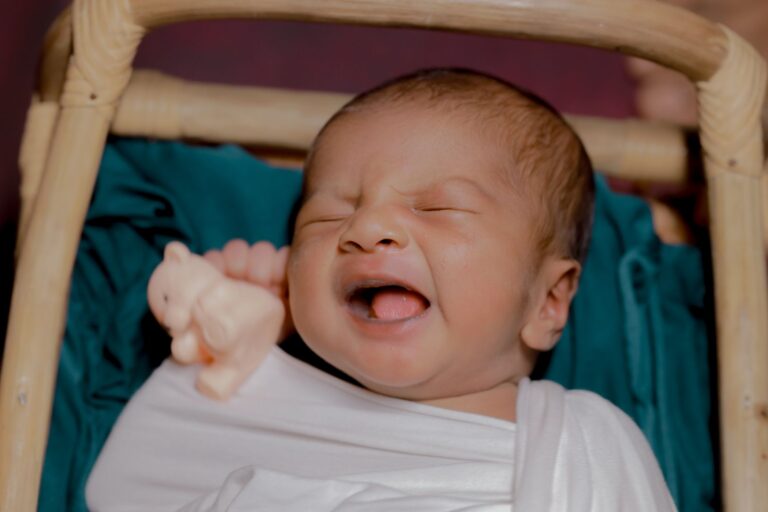
A newborn's first sounds are cries and grunts of discomfort or hunger. By two to three months, babies begin to coo—making vowel sounds like "oh" and "ah" in response to conversation. These cooing sounds are not speech yet, but they are the baby's way of practicing voice and responding to what they hear around them.
Babies at this age are also listening and learning the rhythm and pattern of their language, even though they cannot yet use words. They turn toward voices, react to different tones, and begin to recognize familiar speakers. A parent's exaggerated tone of voice and the repetition of sounds naturally supports this early listening. Hearing is essential for language development.
Most hospitals screen newborns' hearing before discharge, but if a hearing screen was missed or results were unclear, bring it up with your pediatrician. Undetected hearing loss in infancy can delay speech and language for years, and early detection and support make an enormous difference. Babies vary in how vocal they are. Some coo constantly; others are quieter and more observant.
Both patterns can be completely normal. If your baby does not seem to react to loud sounds or voices by three to four months, mention it at a check-up—not as an emergency, but as something worth confirming.
Babbling and Comprehension—Six to Twelve Months
Between six and nine months, babies begin to babble—repeating sounds like "ba-ba-ba" and "da-da-da" with strings of the same syllable. Babbling is louder, more varied, and more intentional than cooing, and it shows that the baby is learning to control mouth movements and experimenting with sounds their language uses. By around nine to ten months, babies often begin to understand simple words in context, though they cannot say them yet.
A baby might turn when they hear "mama" or look toward the door when you say "bye-bye." This comprehension grows before production—babies understand far more than they can say. Around this same time or slightly later, some babies begin to wave bye-bye or clap, and they start to use gestures to communicate. Pointing, reaching, and shaking the head are all early forms of communication that develop alongside sounds.
A baby who gestures and babbles is making progress in communication, even without words. Babbling becomes more varied by twelve months, with less repetition and more changes in pitch and rhythm. Many babies have one or two words by their first birthday—"mama," "dada," or a name—though some children do not say recognizable words until well into the second year and still develop normally.
Different languages use different sounds, and babies are already beginning to narrow down to the sounds of the language they hear most. A baby hearing English starts to drop sounds from other languages and focuses on English sounds and patterns. This is normal brain development, not a limit.
First Words and Early Understanding—Twelve to Eighteen Months
Between twelve and eighteen months, many children say their first real words—words connected to meaning, not just sounds. First words are often names of people ("mama," "dada"), animals ("dog," "cat"), or important objects ("ball," "milk"). Some children have several words; others may have just one or two, and both are within the range of normal.
Understanding grows faster than speech. A child with just a few words may understand twenty, fifty, or more. You might notice they respond to their name, follow one-step directions like "get your shoe," or point to objects when you name them. This understanding is crucial—it means the language is getting in, even if it is not coming out yet.
Around fifteen to eighteen months, children often go through a "vocabulary spurt," suddenly adding many words over a few weeks. Others add words more gradually, one or two at a time. A few children have an initial quiet period where they seem to be listening and observing without much talking, and then language catches up.
All of these patterns can be normal. Gestures continue to matter. Children at this age may point to request things, use gestures to greet or show off, and imitate actions. Combining gestures with sounds or words—pointing at a dog and saying "dog," or reaching with an open hand and saying "up"—shows that language is developing on schedule.
By eighteen months, screaming, whining, or pointing without words is the main way some children communicate, while others are already putting two words together. The range is wide. If you are worried about any aspect of your child's hearing or sounds, your pediatrician can refer you to a speech-language pathologist for a checkup.
Two-Word Phrases and Grammar Beginnings—Eighteen to Twenty-Four Months
Between eighteen and twenty-four months, many children begin to put two words together: "more milk," "dada home," "all done." These two-word combinations show that the child is learning grammar at a basic level—pairing a noun with another word to carry meaning. The order might not always be perfect, but the child is using words to describe what is happening.
Vocabulary typically grows during this period, often quite rapidly. A child might go from fifty words to two hundred words between eighteen and twenty-four months. This growth varies tremendously; some children are still below fifty words at twenty-four months and catch up over the next year, while others are already combining words in longer phrases.
Pronunciation is still imperfect. "Banana" might sound like "nana," "dog" might be "dah," and "water" might be "wawa." Simplified pronunciations are expected and normal—the child's mouth is still learning motor control. By age four or five, most children's speech becomes clear enough that strangers can understand them most of the time. Children at this age still understand far more than they speak.
They follow two-step directions ("get your shoes and your coat"), identify body parts, and recognize the names of familiar people and objects. Understanding lags speech are rare; much more commonly, a child understands well but talks less than peers. Gestures, sounds, and play become more complex. A child might pretend to drink from a cup, push a toy car, or pat a doll's back. Play and language develop together, and a child who plays with purpose and imagination is usually making progress in all areas.
Storytelling and Complex Speech—Two to Four Years
Between ages two and three, children's sentences grow longer and more complex. They add words like "is," "the," and "and" (called function words), begin to ask questions with "what," "where," and "why," and tell short stories or descriptions of things that happened. Speech becomes more recognizable to people outside the family. By age three, a child's speech should be intelligible to most people most of the time, though some sounds may still be simplified.
By age four, clarity improves further, and most children can tell detailed stories, ask complex questions, and use language to express feelings and ideas. Grammar develops gradually and often unevenly. A child might say "I goed" before learning "I went," or create other interesting mistakes ("two foots," "he don't") as they figure out the rules.
These errors show that the child is learning patterns—not that anything is wrong. Vocabulary by age three is often in the range of three hundred to one thousand words, though the range is very wide and depends partly on how much language exposure the child has at home. Some three-year-olds are much more talkative than others, and quieter children can be developing language normally.
Back-and-forth conversation becomes more possible. A child can answer simple questions, tell you what happened during the day, and share preferences and feelings. They may also talk constantly, ask endless questions, or tell long stories—all normal variations.
What Counts as a Speech Delay
A speech delay means a child is not meeting language milestones for their age. Because the range of normal is wide, delays can be hard to spot, and the definitions used by schools and clinicians are not the same as common concerns parents have. By age two, children who are not putting two words together, or who are not saying at least twenty to fifty words, are sometimes considered to have a delay—though many children this age are not yet combining words and develop normally.
A more reliable sign of concern is a child who is not understanding much language, not using any gestures, or not responding to their name. Understanding and gestures are usually the first things to check. By age three, a child who is not using three-word combinations, whose speech is largely unintelligible to strangers, or who is not interested in communicating usually benefits from an evaluation.
At four, most children's speech should be fairly clear, and they should be able to tell simple stories and follow multi-step directions. There is overlap between normal development and delay. Some perfectly normal children develop language later and catch up completely by school age. Others have genuine delays that benefit from support. The only way to know is through careful observation and, if there is doubt, an evaluation by a professional.
Boys as a group tend to talk later than girls on average, but the range for boys spans the entire normal range. A late boy is still a normal boy. Similarly, children who hear multiple languages may talk a bit later and mix languages, which is normal bilingual development—not confusion.
How to Support Speech and Language at Home
Talking to your child is the single most powerful thing you can do. Running narration—describing what your child is doing, seeing, or hearing as it happens—feeds language directly. "You are stacking blocks. That red block is on top of the blue one. Now it is falling!" gives the child language to match the experience. Conversation with turns is especially helpful.
Instead of talking at your child, create back-and-forth exchanges. If your child points and says "dog," you might say "Yes, that is a big dog. Do you see his tail?" and wait for a response. Pausing and listening to your child, even if the response is a sound or gesture, reinforces the turn-taking that conversation needs.
Reading together daily supports language growth. The vocabulary in books is richer and more varied than everyday speech, and stories expose children to narrative structure. You do not have to read cover to cover; stopping to point, ask questions ("Where is the cat?"), and talk about the pictures is just as valuable. Children also learn to love books through these shared moments.
Singing, nursery rhymes, and fingerplays are language-rich and fun. The rhythms and repetition in songs and rhymes help children notice the sounds of language. They also give opportunities for back-and-forth play and anticipation—"One, two, three" and then the tickle comes. Limiting screen time helps. Background television or videos do not teach language the way face-to-face interaction does.
If you use screens, watching together and talking about what you see is far more helpful than having your child watch alone. The American Academy of Pediatrics recommends minimal screen time before age two and no more than an hour a day of quality programming at ages two and up. Play is language practice. Blocks, toy animals, dolls, balls, and pretend play all give your child chances to learn words, practice sounds, and tell stories.
You do not need expensive toys; pots, spoons, and boxes are just as good. The play matters, not the toy.
Bilingualism and Language Exposure
Children who hear more than one language learn both. Learning two languages is not a delay or a burden—it is an advantage that comes with different pacing. Bilingual children often talk slightly later than monolingual peers, but they catch up and end up fluent in both languages. Bilingual children may mix languages, especially when first starting to talk, and this is normal and expected.
A bilingual two-year-old might say "más crackers" (more crackers in Spanish-English mix). This mixing does not mean the child is confused; it is how bilingual people communicate, and it often fades as the child becomes more fluent. The amount of language exposure matters. A child who hears language regularly in both languages will develop both.
If one language is heard much less frequently, that language may develop more slowly. Living in a community where one language is dominant (like Spanish-speaking children in an English-majority school) often means the minority language develops more slowly unless there is active family support. There is no evidence that raising a child bilingually causes confusion or delays compared to monolingual development.
Bilingual children use more total words spread across two languages than monolingual children use in one, so comparing word counts directly can be misleading. For children with speech delays or concerns, having support in the home language(s) is important. A speech-language pathologist can tell you whether a child truly has a delay or whether what you are seeing is normal bilingual development. Some clinicians specialize in bilingual children; ask your pediatrician if a referral is needed.
Signs to Bring to Your Pediatrician
By age twelve months, concerns worth mentioning include: not responding to their name, not using any gestures like waving or pointing, not babbling, or not showing interest in back-and-forth games like peek-a-boo. Hearing concerns from infancy onward also merit checking. By age two, concerns include: fewer than fifty words, not understanding simple instructions, not pointing to show you things, not interested in interaction or play, or sounds so unclear that family members cannot understand much.
Late talking alone—even quite late—is not always a concern if the child understands language and communicates in other ways. By age three, concerns include: speech that is hard to understand outside the family, not able to tell you simple things about the day, very limited vocabulary, not interested in conversation, or using words in odd ways or repeating the same words or phrases without real understanding.
Concerns are not emergencies, but they are worth documenting. Write down what you have noticed and when. If the pediatrician is not concerned but you are, ask about getting an evaluation anyway—school districts offer free speech and language evaluations starting at age three. A child with a concern early on may catch up on their own, may benefit from strategies at home, or may need professional support.
Early attention does not cause harm and often helps. The question is never whether to worry; it is what information you need to make the best decision for your child.
When to Seek a Speech-Language Evaluation
A speech-language pathologist (SLP) is a professional trained to assess and support language and speech development. An evaluation is not a scary test; it is a way to find out whether a child is developing typically or whether support would help. Many areas offer free evaluations through the school district starting at age three. These are available even if a child is not yet in school.
Call your local school district to ask about early intervention or special education evaluation services. Evaluations are free because language and speech development affects school readiness and learning. For children under three, early intervention programs in your state provide free or low-cost evaluations and support. Contact your pediatrician or search online for your state's early intervention program.
These services are designed to start help as early as possible. Private speech-language pathologists also provide evaluations and therapy. Ask your pediatrician for a referral or search your insurance for in-network providers. If cost is a barrier, some SLPs offer sliding scale fees or you can ask about options. An evaluation will tell you whether your child has a delay, what kind of support might help, and whether a child is progressing well enough to monitor at home.
Sometimes the answer is "developing typically" and you get reassurance. Sometimes the answer is "a little late, but catching up" and you get strategies to use at home. Sometimes the answer is "would benefit from support" and you get a plan. There is no age too early to get an evaluation if you have concerns, and no age where it is too late to see improvement with support. Early childhood is when the brain is most ready to learn language, so starting early is wise when there is any concern.
Frequently Asked Questions
When do babies say their first words?
Many babies say recognizable first words between twelve and eighteen months, though some say words earlier and others wait until after age two. Understanding language comes first; a baby may understand fifty words before saying a single one. Variation this large is still normal.
What is babbling and when does it start?
Babbling begins around six to nine months as repetitive sound play like "ba-ba-ba" and "da-da-da." It shows the baby is learning to control mouth movements and experimenting with sounds. Before babbling, babies coo (making vowel sounds) starting around two to three months.
My two-year-old is not combining words yet. Should I be worried?
Not necessarily. Many two-year-olds are not yet combining words and develop normally. More important is whether your child understands language, responds to their name, uses gestures, and seems interested in communicating. If any of these seem limited, mention it to your pediatrician—not as an emergency, but for guidance.
Is mixing languages a sign that my bilingual child is confused?
No. Bilingual children mix languages early and this is normal; it is not confusion. Bilingual development may be slightly slower at first because the vocabulary is spread across two languages, but children typically become fluent in both over time.
What should I do if I think my child has a speech delay?
Start by mentioning your concerns to your pediatrician, who can help you decide whether an evaluation is needed. If your child is three or older, you can request a free evaluation through your school district. For children under three, look into your state's early intervention program.
How much does screen time affect language development?
Background television and videos do not teach language the way face-to-face interaction does. Watching together and talking about what you see is better than watching alone. The American Academy of Pediatrics recommends minimal screen time before age two and no more than an hour a day of quality programming for ages two and up.