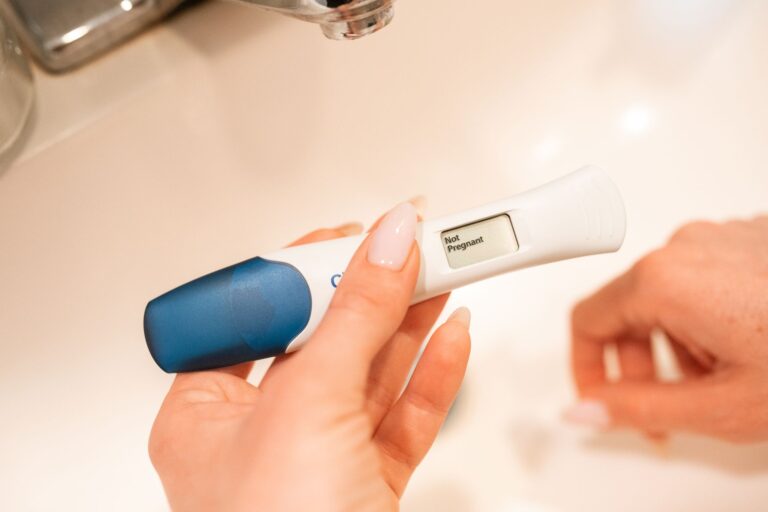
Take a pregnancy test at least 12 to 14 days after unprotected intercourse for the most reliable result, or from the first day of your missed period. Home urine tests detect human chorionic gonadotropin (hCG), a hormone your body produces after a fertilized egg implants in your uterus, and modern tests are highly accurate when used correctly—but the day you test matters more than the test itself, because hCG takes time to build to detectable levels. If you're reading this at 3am with a test in your hand, here's what you need to know: testing too early gives false negatives (the test says no, but you may be pregnant).
Blood tests detect pregnancy earlier than urine tests. A single negative result does not rule out pregnancy—it may only mean the hormone level is still too low. This article covers when to test, why timing matters, what can go wrong, and what to do next.
Table of Contents
- How Pregnancy Tests Work
- Timing: When Your Test Will Actually Detect Pregnancy
- Types of Tests and Their Differences
- What Affects Test Accuracy
- Reading Results Correctly
- Testing After Different Scenarios
- What Comes After a Positive Result
- Handling Negative Results and Retesting
- Special Circumstances and Uncertainty
- When to Skip the Home Test and Call Your Doctor
- Frequently Asked Questions
How Pregnancy Tests Work
A pregnancy test looks for hCG, a hormone produced by the placenta after implantation occurs. Implantation typically happens 6 to 12 days after ovulation, but the timing varies. Once implantation begins, hCG enters your bloodstream and gradually appears in urine, where home tests detect it.
The hCG level doubles roughly every two to three days in early pregnancy, especially in the first four weeks after a missed period. This means a test taken one day too early might show negative, but the same test tomorrow could show positive. Your body doesn't produce hCG on a fixed schedule—it depends on when ovulation happened and when implantation occurred.
Urine tests measure hCG concentration in millimeters per liter (mIU/mL). Each test brand has a sensitivity threshold—the lowest hCG level it can detect. Sensitive tests detect hCG around 10 to 15 mIU/mL; standard tests need 20 to 25 mIU/mL or higher. A test with "early detection" in the name is simply more sensitive, not more accurate at any given hCG level.
Blood tests, ordered by a doctor, detect hCG sooner and at lower levels than urine tests. A quantitative blood test (beta hCG) measures the exact hCG amount, while a qualitative test just confirms presence or absence. Blood tests can show positive 8 to 10 days after ovulation—several days before a urine test would. The test result depends entirely on hCG presence and concentration, not on symptoms, cycle length, or how badly you want to be pregnant. Two people with identical hCG levels will show the same result on the same test, regardless of anything else about them.
Timing: When Your Test Will Actually Detect Pregnancy
The most reliable time to test is 14 days after intercourse or from the first day of your missed period. At 14 days post-intercourse (or day 28 of a typical 28-day cycle), hCG is almost always high enough to show on a home urine test if you are pregnant.
If your cycle is longer than 28 days, waiting until your period is actually late matters more than a specific calendar date. A 35-day cycle means ovulation happens around day 21, and testing on day 35 is equivalent to testing at day 14 post-ovulation—the right timing. Testing before a missed period is possible but comes with risk.
A test at 10 days post-intercourse might be negative even if you're pregnant, because hCG levels are still rising. Early-detection tests are somewhat more sensitive, but "sensitive" still has limits. If you test early and get a negative result, plan to test again in a few days.
Testing too early is the main reason for false negatives. If your test is negative but you still haven't gotten your period, retest in three to five days. hCG doesn't stay the same—it keeps rising, and a negative test today can become positive in 48 hours. The time of day matters slightly. First-morning urine has higher hCG concentration because urine is more concentrated after sleep.
If you test later in the day, hCG may be diluted by water or other fluids you've consumed. For the most reliable result, use first-morning urine and follow the test instructions exactly.
Types of Tests and Their Differences
Home urine pregnancy tests come in stick form, midstream cassette form, or digital displays. All of them detect hCG in urine the same way. The main difference between brands is sensitivity: how low an hCG level each test can detect. No home test is inherently more "accurate" than another at the same hCG level, but more-sensitive tests detect pregnancy earlier.
Digital tests display "pregnant" or "not pregnant" instead of lines, which removes the guesswork about what a faint line means. They cost more but may reduce anxiety about interpreting results. They are not more accurate; they just present the result differently. Disposable strips are cheaper but require careful technique—you need to hold them at the right angle in urine for the right number of seconds.
Cassette tests have a well you drop urine into and are less likely to be mishandled. Choose whichever type you'll use correctly. Blood tests are ordered by a doctor or clinic and are the most sensitive way to detect pregnancy. Quantitative blood tests show the exact hCG number, which is useful if a doctor needs to track whether levels are rising normally.
Blood tests can show positive before a home urine test can. Store-brand and name-brand tests have no meaningful difference in accuracy at the same sensitivity level. The price difference typically reflects packaging, marketing, and whether the brand includes early-detection claims. A $1 test and a $15 test work the same way if they have the same mIU/mL sensitivity.
Evaporation lines are a real problem with cheap or low-quality tests. An evaporation line is a faint mark that appears as urine dries—it looks like a very faint positive but is not a positive result. Always read the test within the time window specified in the instructions, not later. Digital tests eliminate this problem.
What Affects Test Accuracy
The hCG level in your urine depends on several things: how far along you are, whether implantation happened normally, and whether your pregnancy is developing typically. Even if you use a test perfectly, accuracy depends on whether enough hCG is present. Diluted urine lowers hCG concentration. If you've drunk lots of water or other fluids, your urine is dilute and may test negative even if you're pregnant.
First-morning urine is more concentrated and is the better choice. If you must test later in the day, don't drink water right before the test. Some medical conditions and medications affect hCG. Certain fertility treatments, including hCG-trigger shots used before egg retrieval, put synthetic hCG into your system, making a home test positive even if you're not pregnant.
If you used an hCG trigger shot, your doctor will tell you when hCG from the injection clears and testing becomes meaningful (usually 10 to 14 days). Ectopic pregnancy (implantation outside the uterus) still produces hCG and will show a positive home test. However, an ectopic pregnancy may produce hCG more slowly or less robustly than a normal pregnancy, and hCG levels may not rise as quickly.
If you test positive but something feels wrong or your hCG numbers seem low, tell your doctor. Pituitary or thyroid disorders, ovarian cysts, and some cancers produce hCG or similar hormones, causing a false positive. This is extremely rare, but a positive test should always be confirmed by a doctor. Do not assume you're pregnant based on a single home test.
User error is common. Not following the instructions, reading the test outside the specified time window, or using old tests can give false results. Always check the expiration date on the test box. Store tests in a cool, dry place—not a steamy bathroom.
Reading Results Correctly
A positive result shows two lines (or "pregnant" on digital tests). Even a very faint second line is a positive result if it appears within the time window. Faintness does not mean the pregnancy is weaker or less real—it reflects the hCG level at that moment. A negative result shows one line only. The absence of a second line is the result, not a very faint line.
If you see only one line within the test window, the test is negative. An evaporation line appears as urine dries—usually 10 or more minutes after you do the test. It is a faint gray or light pink line, not colored like a real positive line. Always read your test within the time window specified (usually three to five minutes), not afterward.
False positives (the test says positive, but you're not pregnant) are rare with modern tests. They occur if you used hCG-trigger medication, have certain medical conditions, or the test is faulty. A positive result should be followed by a doctor's test to confirm. False negatives (the test says negative, but you are pregnant) are much more common, especially with early testing.
The hCG level is simply too low to detect. If your period is late and a test was negative, retest in a few days or call your doctor for a blood test. A faint positive is still a positive. Some people worry a faint line means a weaker pregnancy, but that's not how it works.
A faint line means the hCG level is present but not high—normal at very early pregnancy. The line will darken over the next few days as hCG rises.
Testing After Different Scenarios
After intercourse without contraception, count 14 days (two weeks) from the intercourse date, or wait until your period is late. If you know your ovulation date (from tracking, ovulation predictor kits, or a fertility clinic), add 14 days to the ovulation date for the best testing day. This assumes implantation happened normally, which it usually does.
After in vitro fertilization (IVF), the clinic tells you exactly when to test, typically 10 to 12 days after egg retrieval. Do not test earlier than instructed—hCG from the hCG-trigger injection used during IVF may still be present. Your clinic's timing is specific to your cycle. After intrauterine insemination (IUI), testing is typically recommended 12 to 14 days after the procedure.
IUI doesn't change the timing of hCG appearance—it just places sperm closer to the egg. Ovulation and implantation still need time. After a miscarriage or abortion, hCG takes time to clear your system. A positive home test after a loss does not necessarily mean pregnancy is continuing. Your doctor will check hCG levels with blood tests to see whether they're falling (indicating the miscarriage is complete) or rising (indicating new pregnancy or incomplete miscarriage).
Do not interpret a home test as proof of anything after pregnancy loss. After stopping hormonal contraception (the pill, patch, ring, or shot), you still need to time the test by your actual ovulation, not your cycle length. Cycles may be irregular right after stopping hormones. If you're trying to conceive after stopping contraception, track ovulation or wait until you've missed a period.
What Comes After a Positive Result
A positive home test should be confirmed by a doctor with a blood test or an office urine test. Blood tests are more precise and can show the exact hCG level, which helps your doctor confirm the pregnancy and date it. You do not need multiple home tests to confirm—one positive is enough to call the doctor.
Call your OB-GYN, midwife, or primary-care doctor to schedule a confirmation appointment. Bring the positive test with you if you have it, though the doctor will likely do their own test. Many clinics now schedule a phone call or telehealth visit first to confirm the pregnancy before an in-person exam. Do not wait for a second positive test to call.
One clear positive is confirmation enough to contact your doctor. Some people retest to "make sure," but if the first test is truly positive, a second test is unnecessary—it will also be positive. Your doctor will want to know the date of your last period, your cycle length, and when you had intercourse (or when you expect you did).
This helps them estimate how far along you are and when to schedule your first ultrasound. Bring a calendar if you need to. Early pregnancy dating may be off by a few days in either direction, which is normal. The first ultrasound, usually around 8 to 10 weeks, is more precise and may adjust the due date.
Don't assume your due date from the first test alone. Blood work at the first appointment includes checks for blood type, Rh factor, immunity to certain infections, and sometimes hCG levels to ensure they are rising normally. These tests establish your baseline and inform your prenatal care for the next nine months.
Handling Negative Results and Retesting
A negative result when your period is on time or early likely means you're not pregnant. If you tested early (before a missed period), a negative result is less reliable—it may just mean hCG is not yet detectable. Plan to retest when your period is actually late, or ask your doctor for a blood test if you can't wait.
If your period is late but a test is negative, wait three to five days and test again. hCG rises quickly, and a negative today can become positive in 48 hours. Do not assume you're not pregnant after a single negative test if your period hasn't come. Repeated negative tests with a late or missing period warrant a doctor's call.
A blood test can detect hCG earlier and more sensitively than a home urine test. Your doctor can also check for other causes of a missed period, such as thyroid disorders, hormonal imbalances, or stress-related anovulation (no ovulation). If you've had repeated negative tests, a late period, and no pregnancy, your doctor may order additional tests to find the cause.
Thyroid function, prolactin levels, and pelvic imaging are common next steps. A persistent absence of menstruation always deserves medical attention, whether pregnancy is the cause or not. Do not assume a negative test means you should stop taking prenatal vitamins or change your habits if you're trying to conceive. If you're actively trying and haven't conceived after a year (or six months if you're 35 or older), contact a fertility specialist.
Many things affect conception timing and success. Testing continuously or obsessively does not change the result and increases stress. If you're two to three days before your expected period and testing negative, wait a few more days rather than testing multiple times daily. Retesting daily wastes money and provides no new information.
Special Circumstances and Uncertainty
If you have irregular cycles, timing a test is harder. Without knowing when you ovulated, you can't count 14 days from ovulation. Instead, test when you're sure your period is late—wait at least five to seven days past your longest normal cycle. If your cycles vary from 25 to 45 days, waiting is the safest approach.
Polycystic ovary syndrome (PCOS) and other hormonal conditions often cause irregular cycles and unpredictable ovulation. If you have PCOS and are trying to conceive, track ovulation with ovulation predictor kits or ultrasound to nail down the timing. Home urine testing alone becomes unreliable without knowing your ovulation date. Thyroid disorders can affect menstrual cycles and hCG levels.
If you have hypothyroidism or hyperthyroidism, tell your doctor when you're trying to conceive. Getting thyroid levels optimized before pregnancy benefits both you and the developing baby. Certain medications affect hCG or hormone levels. Anticonvulsants, some psychiatric medications, and dopamine agonists can interfere with ovulation or hormone production. If you're on any medication and trying to conceive, ask your doctor whether it affects fertility or pregnancy testing.
Breastfeeding delays menstruation in many people, but it's not a reliable contraceptive. If you're breastfeeding and haven't returned to menstruation yet, you can still conceive. If you're breastfeeding and want to know whether you're pregnant, a blood test is more reliable than a urine test, because prolactin (the breastfeeding hormone) can affect urine hCG concentration.
Extreme stress and weight changes can delay ovulation and menstruation. A late period doesn't always mean pregnancy—it can mean ovulation was delayed by illness, stress, travel, or significant weight loss or gain. If you've had a stressful month and your period is late, give it another week before assuming pregnancy, unless you have other symptoms.
When to Skip the Home Test and Call Your Doctor
Skip the home test and call your doctor immediately if you have severe abdominal pain on one side, heavy vaginal bleeding, shoulder pain, or dizziness and you think you might be pregnant. These can be signs of an ectopic pregnancy (implantation in the fallopian tube), which is a medical emergency. An ectopic pregnancy needs doctor care, not a home test.
Call your doctor instead of testing if you're on medications that could affect results (like fertility drugs with hCG) and need clarity on whether a positive test means actual pregnancy. Your doctor can order a blood test to know for certain. If you have a medical condition like liver disease, kidney disease, or certain cancers, or if you've recently had an abortion or miscarriage, ask your doctor whether home testing is appropriate.
A blood test may be more reliable. If you've been trying to conceive for more than six months (or more than a year if you're under 35), don't waste time on repeated home tests. Call a fertility specialist. Early evaluation can identify and treat problems that home testing can't address. If your period has been absent for three or more months and repeated home tests are negative, see a doctor.
Amenorrhea (absence of menstruation) has many causes—thyroid disorder, extreme stress, PCOS, hypothalamic suppression—and all of them benefit from medical evaluation, whether or not pregnancy is the concern. If you are pregnant and test positive, but you have a history of miscarriage, bleeding, or other complications, your doctor will tell you what to do next and may order more frequent hCG checks or early ultrasound. Do not rely on home tests to monitor a pregnancy after a positive is confirmed.
Frequently Asked Questions
Can I test before a missed period?
Yes, but it's less reliable. Most home tests detect hCG 12 to 14 days after intercourse or from the first day of a missed period. Testing earlier may show a false negative because hCG hasn't built up yet. If you test early and get a negative result, retest when your period is actually late.
What does a faint positive line mean?
A faint positive is a positive result. Faintness reflects the hCG level at that moment and doesn't indicate the pregnancy is weaker. The line will likely darken over the next few days as hCG rises. Retest in a few days if you want to see the line get darker, but one positive is enough to call your doctor.
Why did my pregnancy test show negative, then positive a few days later?
HCG takes time to rise. A negative early test means the level was below what the test could detect at that moment. Three to five days later, hCG is higher and a sensitive test catches it. This is not a false result the first time—it's just early testing.
Can medications or health conditions make a pregnancy test wrong?
Yes, in rare cases. HCG-trigger shots used in fertility treatment cause false positives. Certain hormonal disorders, ovarian cysts, and some cancers can also cause false positives. Always confirm a positive home test with a doctor. False negatives are much more common and usually mean you tested too early.
Should I test multiple times a day to be sure?
No. Testing multiple times wastes money and increases stress without providing new information. HCG doubles every two to three days in early pregnancy, not every few hours. Test once every two to three days if you retest, and always use first-morning urine.
How early can a blood test detect pregnancy?
A blood test can detect pregnancy 8 to 10 days after ovulation, several days before a home urine test can. Blood tests are more sensitive and measure the exact hCG level, not just its presence. Ask your doctor for a blood test if you need an early answer.