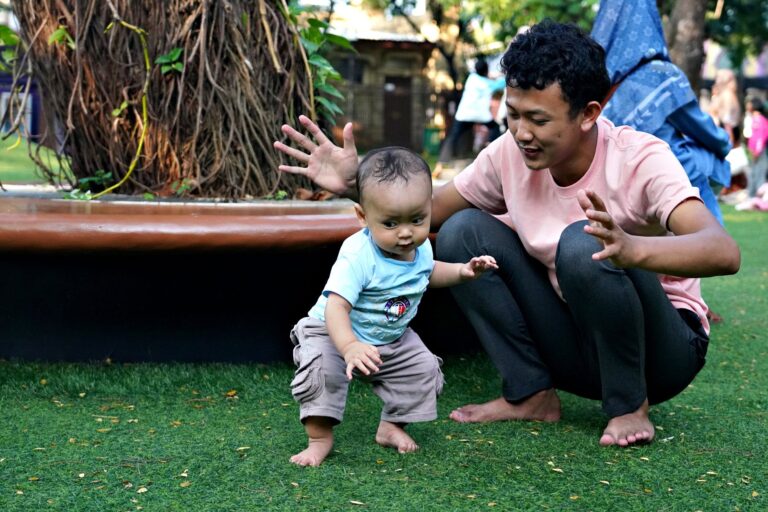
Most babies begin to show purposeful grabbing around 3 to 4 months old, though their hands have been moving since birth. The shift from reflex grasping—where a newborn's fingers automatically curl around anything touching their palm—to intentional reaching and grabbing is one of the clearest early signs that your baby is developing motor control. This milestone typically unfolds gradually over the first year rather than appearing overnight, and the range of normal is wide.
The journey toward grabbing involves several overlapping skills: your baby's brain has to register what they see, decide they want it, coordinate their arms and hands to reach toward it, and then manage their fingers to grasp it. Watching this progression happen is one of the tangible ways you'll see your baby gaining control over their body. Understanding what to expect at each stage can help you recognize when your baby is on track and when something might warrant a conversation with your pediatrician.
Table of Contents
- Your Newborn's Hands and the Grasp Reflex
- The Shift From Reflex to Purpose
- The 4- to 6-Month Turning Point
- What Reaching and Grabbing Look Like at Each Stage
- Handedness and Side Preferences
- Building the Bridge to Fine Motor Skills
- Play and Toys That Support Grabbing Development
- Toys and Objects to Avoid at Each Age
- When Grabbing Seems Delayed
- Typical Variations and When to Relax
- Frequently Asked Questions
Your Newborn's Hands and the Grasp Reflex
Newborns arrive with a built-in grasp reflex that has nothing to do with intention. When you place your finger in a newborn's palm, their fingers curl around it automatically—a reflex governed by their nervous system, not by choice. This response fades gradually over the first few months as your baby's brain develops more intentional control.
If you watch closely, you might notice your newborn's hands moving randomly, opening and closing without purpose. During the first month, your baby's hands are often clenched into tight fists. This is completely normal. By the second month, your baby may begin to spend more time with their hands open, and you might see them bring their hands toward their mouth.
These early hand movements are still mostly reflexive, governed by your baby's developing nervous system rather than conscious decisions. The grasp reflex itself is actually a useful developmental checkpoint. Your pediatrician will often test it during checkups to confirm your baby's nervous system is responding as expected. A baby who loses the reflex too early—before 5 or 6 months—or still has a very strong reflex beyond that point might warrant discussion with your pediatrician, though variations exist.
By the end of the first month, your newborn's hands might occasionally brush their own face or body. This is accidental, not coordinated. They're not yet aware that their hands belong to them or that they can control what those hands do. It takes several more months of neural development before that connection forms. Your baby's vision during the newborn period is still developing.
They can see, but not with sharp focus, and they cannot yet track moving objects smoothly. This matters because grabbing requires your baby to see something and coordinate a reach toward it—skills that don't develop simultaneously.
- —
The Shift From Reflex to Purpose
Somewhere around 2 to 3 months, the grasp reflex begins to weaken, and your baby's hands start spending more time open and active. You may notice your baby watching their own hands with fascination—this is called hand regard, and it marks an important moment. Your baby is beginning to realize those hands are part of their body and they can do something with them.
This realization is a prerequisite for purposeful grabbing. During this period, your baby's reaching becomes less random. Around 3 months, many babies begin to swat at or bat objects dangling in front of them, though the contact is often accidental rather than deliberate. Your baby might hit a hanging toy by chance, be surprised by the movement or sound, and repeat the action—learning that their body can affect the world around them.
The difference between reflex grasping and purposeful grabbing can be subtle. A reflex grasp involves your baby's fingers closing automatically on contact with the palm. Purposeful grabbing involves your baby reaching toward an object, opening their hand as they approach it, closing their fingers around it once contact is made, and potentially bringing it toward their mouth or body to explore.
These are separate neurological processes. Hand-eye coordination develops gradually. Your baby's eyes and brain need to work together to track an object's location, judge its distance, and guide the hand toward it. This coordination isn't present at birth and doesn't mature all at once. Early attempts at reaching may miss the mark entirely. Your baby is learning through trial and error, and missing is part of the process.
By 4 months, most babies have lost the automatic grasp reflex and replaced it with voluntary control. They can reach for objects they see, though their accuracy is still developing. If your baby is 4 months old and you place a toy in their hand, they can hold it for a moment before dropping it—and they will drop it, because releasing grip intentionally also requires motor development.
- —
The 4- to 6-Month Turning Point
Between 4 and 6 months, grabbing becomes noticeably more intentional and coordinated. Your baby can see an object across the room and reach for it with increasing accuracy. The raking grasp—where your baby uses their fingers to rake an object toward their palm like fingers combing through hair—becomes their primary way of picking things up.
This isn't delicate, but it's effective, and it represents real progress in motor control. during this window, your baby's reach becomes more direct. Where earlier attempts might have involved flailing arms and accidental contact, now your baby visibly plans the reach, extends their arm, and manages to contact and grasp the toy.
You might see your baby reaching with one hand, then the other, comparing which reaches are more successful. This trial and error is how babies learn. Your baby's mouth becomes part of the exploration. When your baby grasps something, they bring it directly to their mouth. This isn't unusual—it's how babies explore texture, temperature, and taste.
Every toy ends up in the mouth. This is why toy safety matters so much during this period: anything your baby can grasp, they can bring to their mouth, and anything mouth-sized becomes a potential choking risk. Hand strength develops rapidly during this period. At 4 months, your baby can hold a toy briefly. By 6 months, they can hold it longer and even pass it from one hand to the other, though passing isn't yet reliable.
If you watch closely, you might see your baby deliberately letting go of something—this is just as important as grabbing, because learning to release is part of motor control. Around 5 to 6 months, some babies begin to use a modified grasp where their thumb plays a more active role alongside their fingers. This isn't yet the refined pincer grasp that comes later, but it shows improving coordination. Your baby is moving from raking with all fingers equally toward using different fingers for different purposes.
- —
What Reaching and Grabbing Look Like at Each Stage
At 3 months, reaching is tentative. Your baby might swat at objects hanging above them, but the contact is often accidental. If you watch from the side, you'll see your baby's arm move outward and upward, sometimes missing the toy entirely. This is normal. Your baby's brain is still calculating distance and hand-eye coordination is still developing.
At 4 months, reaching becomes purposeful but not always accurate. Your baby sees a toy and reaches for it, but might not grasp it on the first try. You might see your baby reaching with one hand while the other flails. Some babies begin to use both hands together toward the end of this month, while others still rely primarily on one side.
At 5 months, reaching is more direct and grabbing is more secure. Your baby can see a toy and reach for it with predictable success. The grasp is still primarily the raking grasp, where all fingers curl around the object together. Your baby holds whatever they grasp more securely than before, though dropping is still frequent and usually unintentional.
At 6 months, most babies have moved beyond basic grasping toward more refined manipulation. Your baby can transfer a toy from one hand to the other, can hold something in each hand at the same time, and is beginning to rotate objects to explore them. The grasp is still not delicate, but it's becoming more versatile.
The timeline varies. Some babies show purposeful reaching as early as 3.5 months, while others don't clearly demonstrate it until 5 months. Within the range of typical development, this variation is normal. What matters more than the exact age is the direction of progress—your baby should be gradually gaining more control over the course of several months.
- —
Handedness and Side Preferences
Many parents notice their baby seems to favor one hand or side of the body. Early hand preference doesn't necessarily predict which hand your baby will eventually favor as a writer or artist—that typically solidifies much later in childhood. For now, simply favoring one side during grasping is normal and not a cause for concern.
Some babies show a strong preference for one hand as early as 4 or 5 months, while others remain more ambidextrous for longer. If your baby consistently reaches with one hand and that side seems weaker or less coordinated than the other, that's worth mentioning to your pediatrician, but preference alone is not a concern.
- —
Building the Bridge to Fine Motor Skills
By 6 months, your baby is laying groundwork for the pincer grasp—the refined thumb-and-finger grasp that emerges around 9 to 12 months. Before that, the raking grasp and the simple palmar grasp are your baby's primary tools. These are not stepping stones to get past quickly; they're essential skills that build the foundation for everything that comes later.
Around 8 to 10 months, you may notice your baby beginning to use the thumb more deliberately alongside the fingers, not yet a true pincer grasp but a step toward it. By 10 to 12 months, many babies can grasp small objects between their thumb and one or two fingers, though it's still not as precise as an adult pincer grasp.
The true, refined pincer grasp where the thumb and index finger work together with precision often doesn't emerge until around 12 months or later. This progression happens gradually, and babies don't abandon earlier grasping techniques when they learn new ones. A 12-month-old will still use the raking grasp when appropriate and the pincer grasp when reaching for something small.
They're adding skills to their toolkit, not replacing them. The development of different grasp types matters because it enables your baby to explore objects in new ways. A larger toy can be grasped with the whole hand, while a small toy might require the developing pincer grasp. The variety of grasping techniques allows your baby to manipulate different objects and learn from them.
- —
Play and Toys That Support Grabbing Development
The best way to support your baby's grabbing development is to provide safe, age-appropriate objects to grasp and explore. For the youngest babies, high-contrast cards or simple black-and-white images can draw their attention. As vision improves, bright toys become more engaging. Around 3 to 4 months, toys specifically designed for grasping begin to matter. Rattles, teething rings, and soft toys with handles are good choices.
These give your baby something easy to hold and create an incentive to grab—the sound or sensation the toy produces rewards the effort. Hanging toys that dangle at chest height encourage reaching and batting. Your baby doesn't need many toys. Rotation is more useful than quantity. If your baby sees the same toy every day, they may stop noticing it.
Putting toys away and bringing them out again creates novelty and renewed interest. Three to five toys available at a time is often enough to keep your baby engaged without overwhelming them. Toys made of different materials offer different sensory experiences. Soft fabric toys, hard plastic toys, textured toys, and toys with different sounds all provide different feedback when your baby grasps and manipulates them.
This variety helps your baby learn about cause and effect and builds their understanding of the world. Supervised floor play with toys spread out in front of your baby encourages reaching and grabbing in a natural, unstructured way. You don't need to engineer play activities. Simply placing your baby on a clean floor or play mat with a few toys nearby allows them to practice reaching and grasping at their own pace. Your presence matters—babies are more engaged when someone is nearby.
- —
Toys and Objects to Avoid at Each Age
During the newborn period, your baby doesn't yet grasp deliberately, so standard toy safety guidelines focus on what your baby can't accidentally inhale or choke on if it ends up in their mouth. Nothing with small detachable parts, nothing smaller than a toilet paper tube, nothing that could pose a strangulation risk. From 3 to 6 months, as grasping improves, anything your baby can grab becomes something that will end up in their mouth.
Toys should still be larger than a toilet paper tube. Nothing should have small parts that can be pulled off. Toys should be washable because they will be tested by mouth frequently. Fabric toys should be securely stitched so there's no risk of your baby pulling out stuffing. Toys with strings or cords pose a strangulation risk.
Cords longer than 7 inches can wrap around your baby's neck if your baby rolls or moves. Remove any strings or cords from toys, or ensure they're securely fastened. Avoid toys with long ribbons or ties. Your home will contain objects that aren't toys but will become objects of interest. Remote controls, phone chargers, plastic bags, and small household items attract your baby's grabbing hands.
Baby-proofing means either removing these items from reach or ensuring they're safe if your baby does grasp them. There's no perfect baby-proofing, so supervision remains essential.
- —
When Grabbing Seems Delayed
Every baby develops on their own timeline, and there's a wide range of normal. That said, there are general patterns pediatricians watch for to identify babies who might benefit from early intervention or further evaluation. By 5 months, your baby should be showing interest in reaching for objects, even if the grasp isn't yet reliable.
If your baby seems to have no interest in grasping objects placed in front of them, or if you notice your baby's hands are always clenched and rarely open voluntarily, mention it to your pediatrician. This could indicate a difference in motor development worth evaluating. By 6 months, your baby should be able to grasp a toy that's placed in their hand and hold it at least briefly.
Your baby might pass the toy between hands, might bring it to their mouth, and should show signs of preferring one hand. If your baby can't grasp or hold objects at 6 months, your pediatrician may refer you to a developmental specialist for evaluation. If you notice your baby's grasp is much stronger on one side than the other, or if your baby consistently keeps one hand tightly clenched while the other is open, mention this at a checkup.
These observations could indicate nothing, or they could point toward something worth evaluating. Your pediatrician can help determine what's typical and what warrants further assessment. Early intervention services exist in every state and are free or low-cost. If you have concerns about your baby's motor development at any point, asking for an evaluation is straightforward. An evaluation doesn't mean your baby has a problem; it's simply a way to get professional eyes on development and reassurance or guidance depending on what they find.
- —
Typical Variations and When to Relax
Babies develop in their own order, not on a synchronized schedule. Some babies show strong grasping skills at 4 months, while others take longer. Some babies are intensely interested in toys while others seem less motivated by objects and more interested in people and sounds. These variations are normal and don't predict anything about your baby's future abilities.
Your baby's preferences matter too. Some babies love rattles and reach for them eagerly, while other babies would rather look at your face or listen to your voice. Neither preference is a sign of better or worse development. Babies with different temperaments and preferences will still learn to grasp, just maybe in response to different motivations.
The presence of older siblings or different caregiving styles can affect when and how your baby practices grasping. A baby whose older sibling constantly hands them toys might grasp earlier simply because there are more opportunities for practice. A baby in a quieter environment might focus on grasping at a different pace. Context matters. Premature babies develop on a different timeline.
A baby born at 34 weeks should be evaluated based on their corrected age—the age they would be if they'd been born on their due date—until around age 2. So if your baby was born 8 weeks early, their grasping milestones might appear delayed by about 2 months when measured against their actual age, but when measured against their corrected age they'll be on track.
Your pediatrician will help you figure out which timeline to use. By the end of the first year, almost all typically developing babies are grasping objects, exploring them, and moving toward the refined finger control that comes in toddlerhood. If your baby hasn't reached this point by 12 months, that's worth discussing with your pediatrician—not because there's necessarily a problem, but because early identification and support, if needed, makes a meaningful difference.
- —
Frequently Asked Questions
Is it normal if my baby hasn't grabbed anything by 4 months?
Reaching and grabbing develop gradually, and there's a range of normal. Some babies grasp deliberately at 3 months, while others take until 5 or 6 months. If your baby shows no interest in reaching for objects by 5 or 6 months, mention it to your pediatrician. What matters most is progress over time, not hitting a specific age.
Why does my baby put everything in their mouth after grabbing it?
Babies explore the world through their mouth, especially from 3 to 6 months. This is how they learn about texture, temperature, and whether something is food. This is normal—and why toy safety (nothing smaller than a toilet paper tube, no detachable parts) matters so much during this stage.
My baby is 5 months old and only uses their right hand. Should I be worried?
Hand preference can appear early, even in young babies, and it doesn't necessarily predict which hand your baby will eventually favor as a writer. If your baby is reaching and grasping with the right hand and the left side seems weaker or you notice your baby doesn't move the left side as freely, mention it to your pediatrician.
What's the difference between the grasp reflex and purposeful grabbing?
The grasp reflex is automatic—a newborn's fingers curl when something touches their palm, without the baby deciding to grab. Purposeful grabbing involves your baby seeing an object, reaching for it, and intentionally closing their fingers around it. The reflex fades by 5 to 6 months as your baby develops intentional control.
At what age should my baby use a pincer grasp?
The true pincer grasp—where the thumb and index finger grasp small objects with precision—typically doesn't emerge until 9 to 12 months or later. Before that, your baby uses the raking grasp, where all fingers curl around an object together. Earlier grasping techniques are exactly what your baby needs at that stage.
How many toys does my baby need to encourage grabbing?
A few toys are better than many. Three to five toys available at a time is usually enough. Rotating toys—putting some away and bringing them out again—creates novelty and keeps your baby engaged. Your baby learns more from opportunities to practice grasping different objects than from having a large collection available all the time.