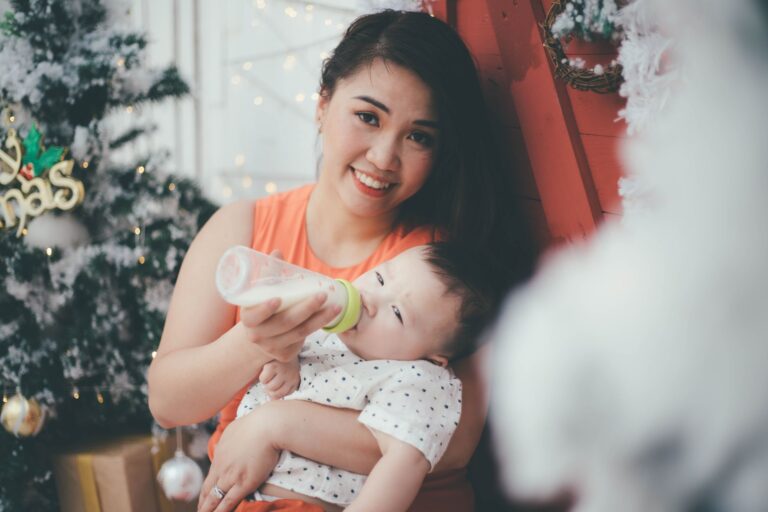
Newborns begin smiling in the first weeks of life, but these early smiles are reflexive movements, not intentional responses to you. Real social smiles—the genuine, delighted expression your baby directs at your face—typically emerge around 6 to 8 weeks of age and become more consistent by 3 to 4 months.
Most parents notice a dramatic shift between month two and month four: the grins become more frequent, more animated, and clearly tied to interaction with people. Your baby's smile becomes a communication tool long before they can speak, signaling recognition, pleasure, and the beginnings of social connection. Understanding the difference between reflex and intent helps you read your baby's development accurately and enjoy each stage rather than waiting for a milestone that may not arrive on a predictable timeline.
Table of Contents
- Reflex Smiles and Real Smiles
- The First Weeks—Reflex and Responsiveness
- The Social Smile Emerges
- Months 3 Through 6—Smiling Becomes Frequent
- Individual Variation in Smiling
- What Can Affect Smiling Development
- When Lack of Smiling Warrants Evaluation
- Building Smiling and Social Connection
- Smiling and Bonding
- Reading Your Baby's Early Expressions
- Frequently Asked Questions
Reflex Smiles and Real Smiles
your newborn's mouth twitches upward during sleep, feeding, or when their face is touched—these are reflex smiles, not social ones. A reflex is an automatic response the nervous system triggers without conscious intention, much like a startle or a grasp.
Reflex smiles happen because of brain development and physical sensation, not because your baby recognizes you or feels happy about your presence. Reflex smiles often appear asymmetrical, involving one side of the mouth more than the other, and they fade quickly without changing your baby's overall facial expression. Your baby may smile while sleeping or even while crying, which can feel confusing to new parents watching for that first "real" smile.
These early smiles serve no social purpose, but they are completely normal and do not tell you anything about your baby's mood or attachment to you. Around 6 to 8 weeks, something shifts. Your baby begins to smile in response to faces, voices, and familiar interactions—smiling becomes directed and purposeful. A social smile engages the whole face: the eyes crinkle, the cheeks lift, and the smile lingers as your baby takes in your expression.
This is when smiling becomes communication, and it marks an important moment in your baby's emerging awareness of the social world around them. The distinction matters because parents sometimes worry needlessly about reflex smiles ("My newborn smiles but doesn't seem happy") or grow impatient for social smiles to arrive ("When will my baby really smile at me?").
Knowing which stage your baby is in prevents false alarm and helps you appreciate the development happening right now, whatever stage that is. Both types of smiles are signs of normal nervous system function, not indicators of your baby's personality or emotional state.
The First Weeks—Reflex and Responsiveness
In the first two weeks of life, your newborn's smiles are almost entirely reflexive, triggered by physical sensations rather than your face or voice. A full stomach, gentle stroking on the cheek, or the relief of passing gas can all produce a smile. Your newborn may smile more during REM sleep, when dreams and random neural activity trigger facial expressions, than during waking hours when they meet your gaze.
By 3 to 4 weeks, your baby becomes more alert during waking periods and may seem to smile more intentionally when they see your face, though this is often still reflexive rather than truly social. Your baby's eyes may track your face, and your baby may be quieter or more content when held by a familiar caregiver, but the smile itself is not yet a deliberate communication.
This is an important distinction: your baby can recognize your face and voice and find comfort in your presence without yet smiling as a social gesture. During weeks 2 through 5, do not expect consistent, directed smiles as proof of bonding. Your baby is busy with survival tasks: eating, sleeping, and gradually becoming more alert to the world.
Smiling requires a level of neural development that simply is not yet in place. Babies who rarely smile in the first month and babies who smile frequently are both developing normally, and neither pattern predicts their personality or your eventual relationship. Some babies seem to smile more in their first month than others, which can be personality, random variation, or how much time they spend in alert, wakeful states.
A baby who sleeps 18 hours a day will have fewer opportunities to smile than one who is alert for longer stretches. This variation is normal and says nothing about the baby's social capacity or your parenting. The real milestone is not whether your baby smiles in week two, but whether genuine social smiling emerges in the weeks ahead.
The Social Smile Emerges
Around 6 to 8 weeks, most babies begin to smile in response to faces and voices in a way that looks intentional and engaged. This is the "social smile," and it represents a genuine developmental leap. Your baby is now recognizing faces as meaningful, responding to interaction, and using the smile as a tool for communication.
The smile becomes animated, involving the eyes and the whole face, and it typically appears when your baby sees you or hears your voice. By 8 to 12 weeks, social smiles become more frequent and more reliably directed toward people. Your baby may smile at strangers as well as familiar caregivers, though smiles for familiar faces often look more sustained and delighted.
This is not a sign that your baby does not prefer you—it is a sign that your baby's social brain is now online and interested in engaging with faces in general. A 10-week-old who smiles at the checkout clerk is showing healthy social development, not lack of attachment. The timing of the first social smile varies widely among typically developing babies.
Some babies begin genuine social smiling by 5 to 6 weeks; others do not until 10 to 12 weeks. Premature babies are typically assessed on their corrected age—the age they would be if born at 40 weeks—so a baby born eight weeks early should be evaluated by their corrected age, not chronological age, when assessing developmental milestones like smiling.
If your baby was born prematurely, count from the due date, not the birth date. A baby who has not smiled socially by 4 months warrants a mention to your pediatrician at the next visit, though this does not necessarily signal a concern—it is simply information your doctor can evaluate in context. Most babies who smile later are developing typically and will catch up; others may have reasons worth understanding early. Your pediatrician has tools to assess social awareness and can guide you on whether further evaluation is warranted.
Months 3 Through 6—Smiling Becomes Frequent
By 3 to 4 months, most babies smile readily and often, directing smiles at familiar faces and sometimes at toys, activities, or even their own hands in the mirror. Smiling becomes a frequent part of interaction: your baby smiles when you smile, smiles when you pick them up, and smiles in anticipation of familiar routines like feeding or a diaper change.
Your baby may coo and smile simultaneously, combining two forms of early communication. Between 4 and 6 months, smiling becomes more nuanced. Your baby may smile more at familiar people than strangers, showing the beginning of social preference. Your baby may also begin to smile as a response to playful interaction—peek-a-boo, tickling, or silly sounds—rather than just in response to being seen or picked up.
Smiles become tied to specific contexts and relationships, showing that your baby is learning the social meaning of the smile. During this window, babies also begin to use smiling strategically, though not consciously. A baby who has learned that smiling brings a parent back for more interaction may smile in anticipation of a caregiver's return or smile to re-engage a parent's attention.
This is healthy social learning, not manipulation—your baby is discovering that facial expressions affect other people's behavior. It is an important step in learning to communicate needs and emotions. Some babies smile less frequently than others even during this peak smiling phase, and this can reflect temperament: some babies are naturally more serious or reserved, and this is not a sign of social difficulty.
A baby who smiles less often but smiles in appropriate contexts, makes eye contact, and responds to interaction is developing typically even if not the biggest grinner. Personality variation is broad and normal.
Individual Variation in Smiling
Babies vary tremendously in how much they smile, just as adults do. Some babies are naturally more expressive and animated; others are more reserved or serious. A baby born to two quiet, reserved parents may smile less frequently than a baby born to exuberant, outgoing parents, reflecting both temperament and genetics. Neither baby is ahead or behind—they are simply different in personality.
Culture also shapes how much babies smile and when they smile. In some cultures, babies are encouraged to be more responsive and animated in social interaction; in others, quieter reserve is valued. These cultural values do not change how babies develop socially, but they do influence how often and in what contexts smiles appear. A baby's smiling frequency is not a measure of their social development or their attachment to you.
Gender differences in smiling are small or absent in early infancy, though some research has suggested that girls may be responded to with more smiling and positive expression than boys, which could shape social behavior over time. In the first year, smiling is driven by developmental stages and individual temperament far more than by gender.
Do not assume that a less-smiley baby is unhappy or that a highly smiley baby is healthier or more socially advanced. Some babies smile more during certain times of day, more when well-rested, or more during certain types of interaction. A baby who rarely smiles when tired but smiles readily after a nap is showing normal variation.
A baby who smiles more with one parent or caregiver than another may have learned that different people respond differently to smiling, or may simply be more comfortable with one caregiver at a particular moment. None of these variations indicate a problem.
What Can Affect Smiling Development
Temperament is the primary driver of how much a baby smiles, but other factors influence smiling too. A baby who is uncomfortable, in pain, or unwell may smile less often. Reflux, ear infections, or other sources of discomfort can reduce social responsiveness. Once pain or discomfort is resolved, smiling typically returns to the baby's baseline.
If your baby seems to have stopped smiling or smiles much less than before, and you notice other changes like feeding difficulties or unusual fussiness, mention this to your pediatrician. Sleep deprivation reduces smiling and social engagement in babies, just as it does in adults. A baby who is overtired may appear withdrawn, make less eye contact, and smile less frequently.
Improving sleep—through establishing a bedtime routine, adjusting daytime nap schedules, or addressing any sleep difficulties—often leads to an immediate return of the baby's more typical social responsiveness. Smiling is energy-intensive from a social perspective, and a tired baby simply has less energy for it. Environmental stress can affect infant social behavior, including smiling. A baby in a chaotic, loud, or stressful environment may become withdrawn.
A baby who has experienced trauma or neglect may show reduced social responsiveness. These effects are real, but they are also reversible: as the baby's environment becomes calmer and more attuned, social engagement typically improves over weeks and months. Early intervention services can help if you are concerned about your baby's social responsiveness in a stressful context.
Some medications or medical conditions can affect smiling and facial expression. Certain neurological conditions, metabolic disorders, or genetic syndromes can influence social responsiveness. Your pediatrician can evaluate whether your baby's smiling pattern fits their overall development and can refer for further evaluation if needed. The key is not to assume the worst, but to mention specific changes or concerns to your doctor.
When Lack of Smiling Warrants Evaluation
Most babies smile socially by 4 months, but the range of normal extends a bit beyond this. A baby who has not smiled socially by 5 to 6 months is developing more slowly than typical in this area and deserves a careful look, though many such babies catch up quickly with time alone. If your baby is not smiling by 6 months, or if your baby smiled previously and has stopped, bring this up at your pediatric visit.
Pay attention to your baby's overall social awareness as well as smiling alone. Is your baby making eye contact? Do they track your face when you move? Do they respond to their name by looking toward you? Do they coo, babble, or make sounds during interaction? A baby who is not smiling but shows other signs of social awareness may simply be a late smiler.
A baby who is not smiling and also avoids eye contact, does not respond to their name, and seems unaware of people around them needs evaluation. Red flags that warrant earlier evaluation include: no social smiles by 5 to 6 months, loss of smiling or other social skills that were previously present, no babbling or vocalization by 6 months, no eye contact with familiar people, and no response to name by 9 to 12 months.
If you notice a cluster of these signs, or if your instinct tells you something is not quite right, ask your pediatrician for a formal developmental screening. Early screening is not diagnosis, but it can identify whether your baby needs additional support. Some developmental conditions, including autism and hearing loss, can affect early smiling and social responsiveness.
Identifying these early allows you to access support services that can help your baby thrive. Many babies who are later identified with these conditions began with slower-than-typical smiling development, but early intervention makes an enormous difference. Screening is not punishment or labeling—it is information that helps you support your baby.
Building Smiling and Social Connection
You do not need to do anything special to make your baby smile—smiling will emerge on its own as your baby's brain develops. However, responsiveness to your baby's smiles builds connection and encourages more smiling. When your baby smiles at you, smile back, use a warm tone of voice, and engage with your baby. Your response teaches your baby that smiling works as communication and that interaction is rewarding.
Talking to your baby, making eye contact, and narrating daily activities help build the foundation for social development. These conversations do not have to be speech-focused or educational; simple narration ("You're getting a fresh diaper now" or "Mommy's right here") gives your baby experience with responsive interaction. Babies whose caregivers respond to their cues—including coos, babbles, and yes, smiles—develop stronger social and language skills over time.
Peek-a-boo, gentle tickling, and other playful interactions often elicit smiles and laughter by 4 to 6 months. These games are not frivolous—they are teaching your baby about turn-taking, cause-and-effect, and the joy of shared attention. If your baby smiles and laughs during play, you are building neural pathways for social engagement. If your baby does not laugh readily, they may enjoy other forms of play, and that is okay too.
Avoid becoming anxious if your baby does not smile as much as other babies you see. Smiling is one small part of development, and it varies widely. Some of the most socially secure, emotionally healthy babies are less smiley than their peers. Your baby's smile frequency does not predict their future personality, intelligence, or wellbeing. Focus on responsive, warm interaction rather than on how often your baby smiles.
Smiling and Bonding
Smiling is often treated as a sign of bonding, but bonding happens through many forms of interaction beyond smiling. A baby who is not smiling much but who reaches for you, sleeps well when held by you, and quiets when they hear your voice is bonded to you. A baby who smiles easily but does not preferentially respond to your comfort may be socially responsive but not yet bonded to that specific caregiver.
Bonding is built through consistency, responsiveness, and physical comfort. Your baby bonds to you by learning that you are available when they cry, that you feed them when hungry, that you keep them safe and warm. Smiling is one signal of bonding, but it is not the only one or even the most important one.
Some babies are naturally less smiley and bond just as securely as smiley babies. By 6 to 9 months, most babies show a clear preference for their primary caregivers and are more willing to smile and engage with familiar faces than strangers. This is called stranger wariness or social discrimination, and it is a sign of normal development, not a sign of a problem with the stranger.
Your baby is learning that different people are different, and that familiar people are safe. This wariness often emerges around 6 months and fades over the second year as your baby becomes more confident and develops a larger circle of trusted people. The goal is not to have a baby who smiles constantly or readily at everyone.
The goal is to have a baby who gradually becomes more socially engaged, who shows preference for people they know, and who uses smiling and other forms of communication to connect. A baby who rarely smiles but clearly prefers you and seeks your comfort has healthy bonding. Trust your baby's behavior overall, not just their smile frequency.
Reading Your Baby's Early Expressions
Your baby's facial expressions carry meaning long before words arrive, but early expressions are still limited in what they communicate. A newborn's grimace might look like a smile; a 3-month-old's smile might look like a grin of recognition when it is actually a reflex triggered by a full stomach. Learning to read your baby's actual state beneath the expression takes time and attention.
By 3 to 4 months, you will become skilled at knowing your baby's different cries, different types of fussiness, and different moods from their overall demeanor, not just their smile. Some of this learning is conscious; much of it happens automatically as you spend time with your baby. You will learn that your baby's smile-like expression during sleep is not a smile, and that your baby's goofy grin after a feeding means contentment.
A baby's smile in the fourth month is worth celebrating, but so is a baby's serious expression while intently watching a toy move. A baby's animated grin is delightful, but so is a baby's quiet, focused gaze while listening to your voice. Smiling is one form of engagement, not the only valuable expression. As your baby grows, you will see a range of expressions—curiosity, concentration, surprise, delight—and each is meaningful.
Do not compare your baby's smiling to other babies you see, especially in brief encounters. You have no idea whether another baby is having a good day, whether they slept well, whether they are in a familiar setting, or what their baseline smiling rate actually is. Your baby's smiling should be evaluated only against your baby's own baseline and development over time, not against other children. Trust what you observe in your own baby over many interactions, not what you see in a stranger's baby on one outing.
Frequently Asked Questions
Is my newborn smiling, or is it just gas?
In the first weeks, smiles are reflex responses to physical sensations, not emotion. Your newborn may smile while sleeping, during feeding, or when their cheek is touched. True social smiles that respond to your face emerge around 6 to 8 weeks.
When should I expect my baby to smile at me?
Most babies begin to smile in response to faces and voices between 6 and 8 weeks of age. If your baby was born prematurely, count the age from the due date, not the birth date. A smile by 4 months is typical, but some babies start a bit later.
My baby is 3 months old and rarely smiles. Is something wrong?
A 3-month-old who rarely smiles but makes eye contact, responds to your voice, and is engaged during interaction is likely developing normally—some babies are simply less smiley. If your baby avoids eye contact, does not respond to your voice, or seems withdrawn, mention this to your pediatrician.
Do babies who smile less develop differently than babies who smile a lot?
Smiling frequency varies with temperament and personality, not with development. A baby who smiles less but engages socially in other ways is developing typically. Frequent smiling does not indicate advanced development, and infrequent smiling does not indicate a delay.
My baby smiled for a few weeks and then stopped. Should I be worried?
A temporary decrease in smiling can happen with teething, illness, sleep deprivation, or a developmental leap. If your baby's smiling has stopped and you also notice other changes like reduced feeding or unusual fussiness, contact your pediatrician to rule out infection or discomfort.
Does my baby smile less because they do not bond with me?
Bonding is built through consistency, responsiveness, and comfort—not through smiling frequency. A baby who reaches for you, seeks your comfort, and calms when you hold them is bonded to you, even if they do not smile often. Trust your baby's overall behavior, not just smiling.