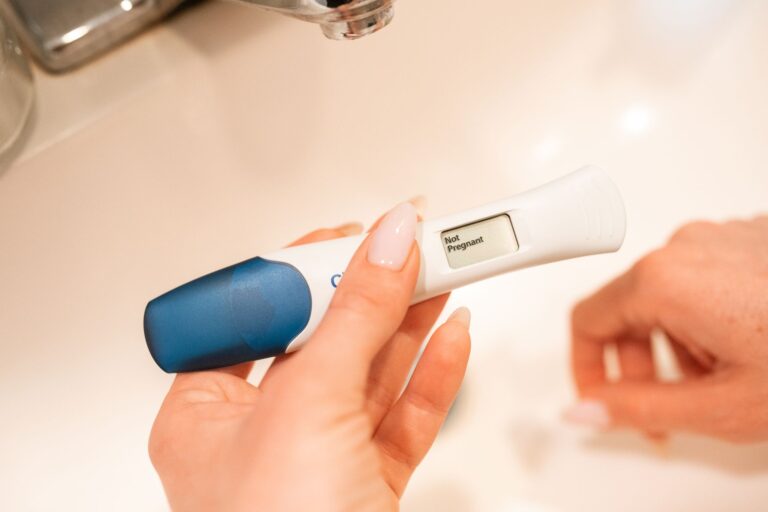
You can reliably test for pregnancy about one week after a missed period, or 12 to 14 days after ovulation. Most home urine tests work accurately at this point because the hormone hCG (human chorionic gonadotropin) has built up enough to detect.
Testing earlier than this often produces false negatives—not because something is wrong, but because hCG levels are still too low for the test to find them. If you cannot wait for a missed period, a blood test ordered by your doctor will detect pregnancy about six to eight days after ovulation, earlier than any home test. The timing depends partly on when you ovulated, which many people do not know exactly, so home test guidance focuses on the missed period milestone: it is reliable, easy to track, and works for most cycles.
Table of Contents
- How Pregnancy Tests Detect hCG
- Timeline: When hCG Appears After Conception
- Using Home Urine Tests Correctly
- Blood Tests: Earlier and More Sensitive
- False Negatives: Testing Too Early
- False Positives: Rare but Real
- Test Sensitivity: Does the Brand Matter?
- Tracking Your Cycle: Why Timing Helps
- Taking Your Next Steps After a Positive Test
- Special Situations: Irregular Cycles and Fertility Treatment
- Frequently Asked Questions
How Pregnancy Tests Detect hCG
pregnancy tests—whether urine sticks or blood draws—all measure the same thing: hCG, a hormone your body produces only during pregnancy. hCG appears when the fertilized egg implants into the uterine lining, usually about six to twelve days after ovulation.
Before implantation, no hCG is present, so no test will detect pregnancy. hCG levels rise predictably after implantation. They roughly double every two to three days in the first month, then rise more slowly. A blood test can detect hCG at levels as low as 1 to 2 mIU/mL (milli-international units per milliliter). Home urine tests typically detect it at 20 to 25 mIU/mL or higher, depending on the brand.
This difference in sensitivity matters. A blood test catches pregnancy earlier because it detects much smaller amounts of hCG. Urine tests are less sensitive partly by design—they are meant to be simple and fast—and partly because urine is diluted. First-morning urine is more concentrated and more likely to show a positive result than later urine.
The hormone itself is real and measurable. Tests do not guess; they respond to hCG presence or absence. A negative test means no hCG was detected at the test's sensitivity level. That can mean you are not pregnant, or it can mean you are pregnant but testing too early.
Timeline: When hCG Appears After Conception
hCG appears in the bloodstream first, usually six to eight days after ovulation. At this point, blood tests can often detect it, but home urine tests almost never can. The hormone has to build up further before it appears in measurable amounts in urine. Ovulation typically occurs around day 14 of a 28-day cycle, though it can happen anywhere from day 10 to day 21 depending on the person.
Implantation happens roughly six to twelve days after ovulation. If ovulation occurred on day 14, implantation might happen around day 20 to day 26 of the cycle. The wider the window for implantation, the wider the window for when hCG first appears. By the time you have missed your period, hCG has usually been building for about one week.
At that point, most people have enough hCG for a home urine test to detect it. Some people test positive a few days before a missed period, especially if they are using a sensitive test and have first-morning urine. Others do not see a positive until several days after. If your cycle is irregular, you may not know when your period was "missed" because you do not track it.
In that case, a blood test is more reliable than trying to guess the right timing for a home test. Your doctor can order a test at any point; there is no downside to testing too late, only to testing too early.
Using Home Urine Tests Correctly
Home pregnancy tests are most accurate when used correctly and at the right time. Using them too early, even a sensitive brand, often yields false negatives. A negative result before your missed period does not mean you are not pregnant; it usually means testing too early. First-morning urine is the most concentrated and gives the best results.
After you wake, the urine has been building in your bladder for several hours. Later in the day, after drinking water or other fluids, urine becomes diluted and hCG becomes harder to detect. If you test later in the day and get a negative result, testing again with first-morning urine may give you a different answer.
Read the test instructions carefully. Most tests work like this: dip the stick in a cup of urine or urinate directly on the stick, wait the specified time (usually two to five minutes), and read the result. A line, plus sign, or digital reading indicates hCG detected. No line or faint line usually means no hCG detected.
Some tests are easier to read than others, and a faint line on an early test may mean low but present hCG. If you get a negative result and still suspect pregnancy—because you have missed your period, have symptoms, or timing suggests you might be pregnant—wait a few days and test again.
A positive test is almost always reliable. A negative test, especially if early, is not as reliable. When in doubt, a blood test ordered by your doctor gives a definitive answer.
Blood Tests: Earlier and More Sensitive
Blood tests detect hCG about one week earlier than home urine tests can, making them useful when you need a faster answer or when testing very early. Two types exist: qualitative, which just says yes or no to hCG presence, and quantitative, which measures the exact hCG level. Qualitative blood tests are reliable about six to eight days after ovulation.
If you know you ovulated on a specific day (from tracking, or from fertility treatment), your doctor can order a blood test at that timing. For most people, though, you do not know ovulation timing precisely, so blood tests are ordered around the time of a missed period or when suspicions arise. Quantitative hCG tests measure the exact hormone level, usually reported in mIU/mL.
These are useful for tracking whether hCG is rising normally, which matters in early pregnancy. A single hCG measurement does not diagnose pregnancy as strongly as one rising over time does. If your doctor suspects issues or wants to confirm a viable pregnancy, they may order blood tests two to three days apart to confirm hCG is doubling.
Blood tests are done at a doctor's office, clinic, or lab, not at home. You need an appointment and a doctor's order. For many people this is actually simpler than multiple home tests—one blood draw gives a definitive answer, no guessing about timing or test sensitivity.
False Negatives: Testing Too Early
The most common reason for a false negative is testing too early. The pregnancy exists, but hCG has not built up enough yet for any test to detect it. This is not a failure of the test; it is about timing. A false negative before a missed period is very common if you test more than a few days early.
Even sensitive home tests may miss hCG if it is present in small amounts. If you test five days before your expected period, you might get a negative result and still be pregnant. Testing again after your missed period usually shows a positive. This is frustrating, but the good news is that early false negatives carry no risk.
A negative result does not harm the pregnancy. Testing negative early does not mean you should change anything about what you eat, drink, or do. Once hCG is high enough to detect, the positive result comes. Repeated negative tests when you are very sure you are pregnant can suggest other possibilities: the pregnancy ended very early (a miscarriage before hCG built up much), conception did not happen, timing was off, or ovulation did not occur that cycle. If you have missed your period by more than a week and multiple tests are negative, talking to a doctor helps sort out what is happening.
False Positives: Rare but Real
False positives—a positive test when you are not actually pregnant—are rare but possible. They usually mean one of a few things: hCG from a very recent miscarriage or ectopic pregnancy still in your system, hCG from fertility medication, a medical issue like certain cancers that produce hCG, or defective test materials. A miscarriage in the week before testing still has circulating hCG.
If you miscarried, a pregnancy test will remain positive for a few days to a few weeks depending on how much hCG was present. The test is not wrong; it is detecting real hCG from the pregnancy that ended. A blood test can track whether hCG levels are rising or falling, which helps clarify whether a pregnancy is ongoing or over.
Fertility medications, including some hormone injections used in assisted reproduction, contain hCG or trigger its release. If you are using these, a positive home test might reflect the medication, not a pregnancy. Your fertility clinic will tell you when it is safe to test and when results are reliable. Rarely, a defective test can show a faint line when none should appear.
This is usually obvious because repeating the test with another brand shows different results. If you get a positive result, either repeating the test or getting a blood test confirms whether hCG is truly present.
Test Sensitivity: Does the Brand Matter?
Home pregnancy tests vary in sensitivity, measured in mIU/mL. A more sensitive test can detect lower hCG levels, making it more likely to show a positive result early. Sensitivity is often marketed as "early detection" or "can detect X days before missed period." Common sensitivities range from 10 to 25 mIU/mL. A 10 mIU/mL test is more sensitive than a 25 mIU/mL test.
However, even the most sensitive home test cannot detect hCG before it reaches its detection threshold, no matter how much better the brand is. A sensitive test taken two days before a missed period might catch a pregnancy early; one taken five days early probably will not, even if it is the most sensitive on the market.
The most expensive tests are not necessarily better at the most important moment—after a missed period. At that point, most tests are similarly accurate. Where sensitivity matters more is very early testing, where spending more might get you an answer a day or two sooner. For most people, the least expensive tests work fine after a missed period.
Test format varies too: sticks you dip or pee on, cups with droppers, or digital readouts. Digital tests remove the guesswork of reading a faint line and show "Pregnant" or "Not Pregnant" in words. Strips and sticks may show unclear results, especially very early. Again, format is preference; accuracy depends more on timing and hCG level than on whether you use words or a line.
Tracking Your Cycle: Why Timing Helps
Knowing your cycle length and when your period typically comes is the simplest way to time a reliable pregnancy test. If your cycle is always 28 days, ovulation probably happens around day 14, and you can expect your period around day 28. Testing on day 29 or 30 catches most pregnancies. Irregular cycles make timing harder.
A cycle can be irregular for many reasons: stress, illness, hormonal birth control effects, or natural variation. If your cycles range from 26 to 34 days, you cannot pinpoint when to test. In this case, waiting until you have clearly missed your normal window is safer than guessing. Or talk to your doctor about ordering a blood test on a specific date without needing to guess.
Tracking your cycle does not require anything fancy. A calendar marking your period start each month shows your pattern over several months. Many people use phone apps, which can predict ovulation and period timing based on cycle history. These predictions improve the more data the app has; they are less accurate with just one or two months of information.
Apps that estimate ovulation do so mathematically, not by any special knowledge. They assume ovulation happens a certain number of days before your next period based on cycle length. If your cycle is irregular, their estimates are more uncertain. For accurate ovulation timing, some people use ovulation predictor kits, which detect the surge in luteinizing hormone that triggers ovulation. These are more precise than guessing.
Taking Your Next Steps After a Positive Test
A positive home test result should be confirmed with a blood test or doctor's appointment. While false positives are rare after a truly positive home test, a doctor's confirmation is the standard first step. Your doctor can discuss next steps, including prenatal vitamins, lifestyle changes, and scheduling an ultrasound. If you are trying to conceive, you might want to know how far along you are.
A blood test can estimate this from hCG levels; an ultrasound can confirm it later. Early pregnancy ultrasounds are usually done around 8 to 12 weeks and confirm the pregnancy is in the uterus (not ectopic), check the heartbeat, and refine the due date. Once confirmed, prenatal care typically involves regular appointments to monitor your health and the pregnancy's progress.
Your doctor may recommend prenatal vitamins with folic acid, discuss diet and exercise, and answer questions about what is safe during pregnancy. The first appointment usually happens around 8 to 10 weeks. If you are not expecting the positive result or unsure about the pregnancy, talking to a doctor is equally important. You have time to consider your options, and your doctor can discuss what support and resources are available. There is no rush to make decisions immediately after a positive test.
Special Situations: Irregular Cycles and Fertility Treatment
If you have irregular cycles, you cannot reliably predict when your period is "missed." Conditions like polycystic ovary syndrome (PCOS), thyroid issues, or significant stress can make cycles unpredictable. In these cases, your best option is to test based on symptoms, time from conception if known, or to ask your doctor for a blood test on a specific date without guessing at cycle timing.
If you are using fertility treatment like intrauterine insemination (IUI) or in vitro fertilization (IVF), your doctor will tell you exactly when to test. They know the date of embryo transfer or insemination and can predict when hCG should appear. Testing before the recommended date defeats the purpose; waiting for the date your clinic specifies gives the most reliable answer.
After miscarriage, hCG can remain detectable for weeks. If you had a recent loss and think you might be pregnant again, hCG levels can distinguish a new pregnancy (hCG rising) from lingering hCG from the loss (hCG falling). A blood test and repeat blood test a few days later clarifies this. If you are on hormone therapy, including birth control, hormone replacement, or other medications, ask your doctor whether these affect pregnancy tests.
Most do not, but some can. Your doctor can tell you whether a positive result is reliable or whether other factors may be in play.
Frequently Asked Questions
Can I test positive before a missed period?
Yes, but only a few days before, and only with a sensitive test and concentrated first-morning urine. Most home tests are reliably positive around the time of a missed period or a few days after.
What does a faint line mean?
A faint positive line usually means low but present hCG, typically from testing very early. Repeat the test in a few days with first-morning urine. Any pink line, even faint, usually indicates hCG is present.
Is a negative test definitive?
No, not if taken before a missed period or very early in pregnancy. Negative before a missed period often means testing too early. If you have missed your period by more than a week and tests stay negative, talk to your doctor.
Do I need to use first-morning urine?
It helps because morning urine is more concentrated, making hCG easier to detect. Tests taken later in the day with dilute urine may show false negatives. If testing later, use a very sensitive test.
When should I call my doctor after a positive test?
Call within a few days to confirm the result and schedule a first appointment. There is no emergency, but early prenatal care matters. If you have had bleeding, severe pain, or other concerns, call sooner.
Can medications cause a false positive?
Fertility medications containing hCG can. Most other medications do not. Certain medical conditions that produce hCG are rare. Ask your doctor if you are on fertility treatment or have unusual circumstances.